

Have you ever seriously thought about investing in a company that for 50 years was associated with databases and lawsuits against its own customers? As recently as the early 2020s, Oracle was a vendor from the past, making its money on complex licensing agreements, penalties for breaking them and endless audits of corporate server rooms. But replacing its database in the critical infrastructure of banks, insurers and government agencies was too expensive and risky, so customers had no other choice.
But over the last few years a huge amount of noise has built up around Oracle. The company ended up in the top 10 largest US companies by market cap. At the same time, its vendor, which seemingly was outdated, suddenly turned into one of the main beneficiaries of the AI boom. Why did this happen? Let’s start, I’d say, with the company’s latest report.
Information can be read in different ways
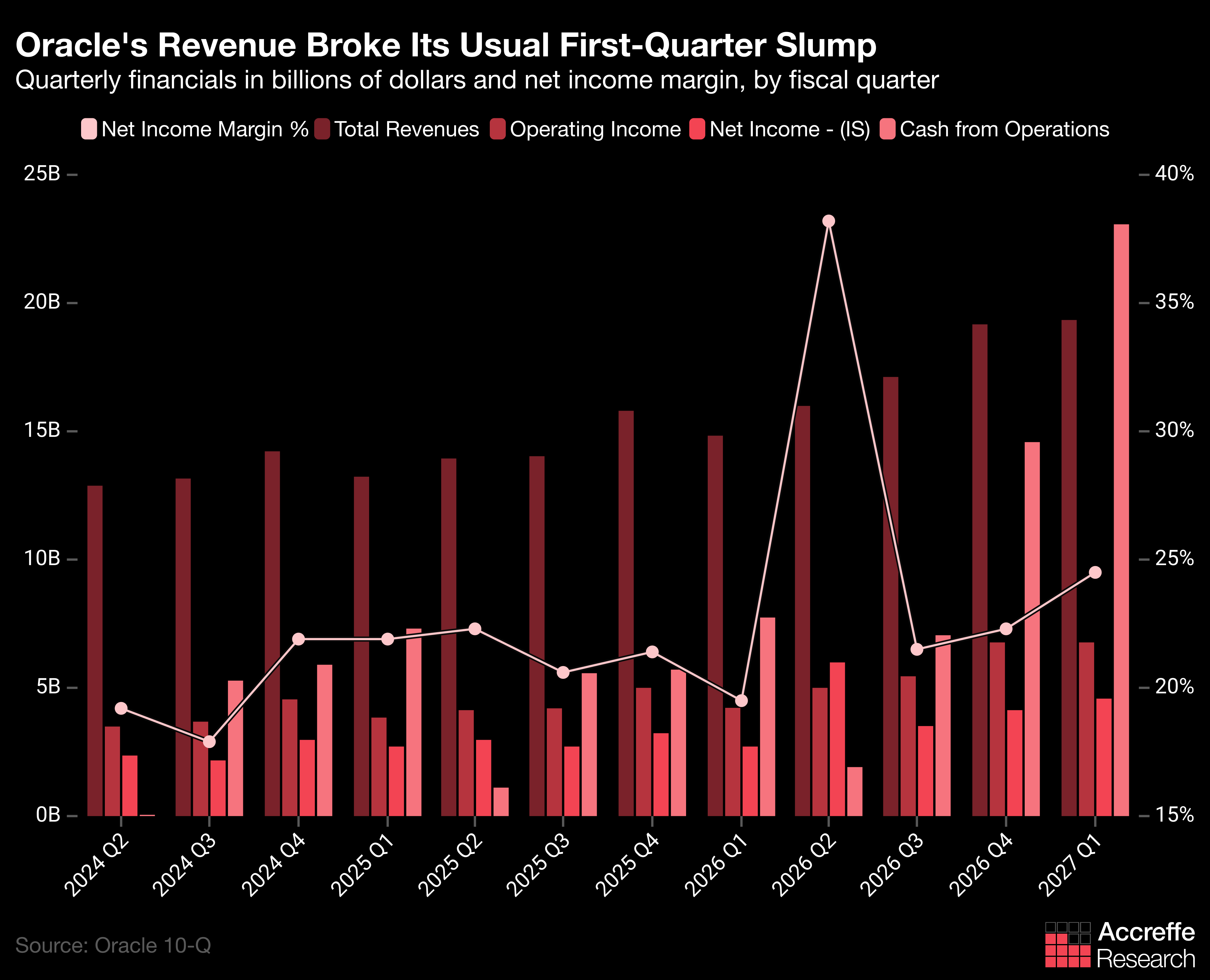
In Q1 FY27 Oracle posted extremely positive results. Revenue came in at a record $19.3 billion, up 30% year over year, and for the first time in the company’s history quarterly revenue also grew sequentially over the previous, much stronger fourth quarter. Because previously, due to seasonality, Q4 was almost always followed by a weaker Q1. This reversal of seasonality suggests the company is most likely moving to steady scale-up.
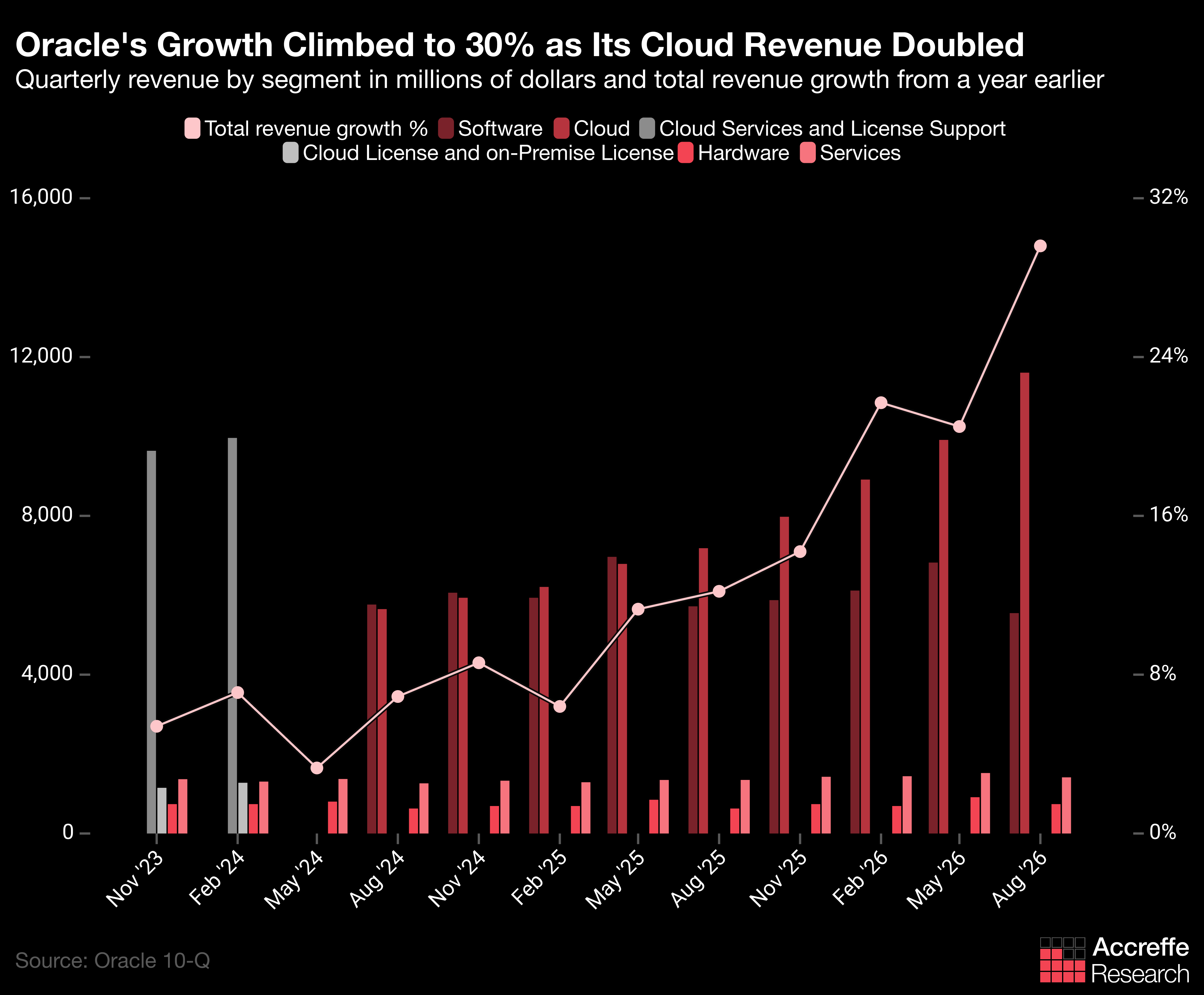
The company’s cloud infrastructure grew 121% year over year to $7.4 billion, accelerating from 93% growth in Q4 FY26. And that’s the ninth straight quarter of accelerating growth. Cloud applications added 10%, with Fusion and industry applications coming in well above that level. Actually, the trend over recent quarters shows the fundamental changes well. Looking back, if in 2024 cloud revenue was on par with software revenue ($5-6 billion), then starting in Q3 FY24 it grew substantially, while revenue from software, hardware and services remains practically unchanged. This is clear confirmation of Oracle’s shift to cloud infrastructure as the company’s main growth driver.
On the face of it, everything’s perfect. But the exact same positive data gives the skeptics grounds for concern. Gross margin fell exactly as the company warned on the last shareholder call, because bringing new data centers online keeps squeezing profitability faster than recognized revenue grows from capacity that’s already live. Operating cash flow for the quarter hit a record $23 billion, CapEx came to $28 billion, and as a result free cash flow for the quarter was negative $5 billion. The company is simply spending every available dollar on expanding construction.
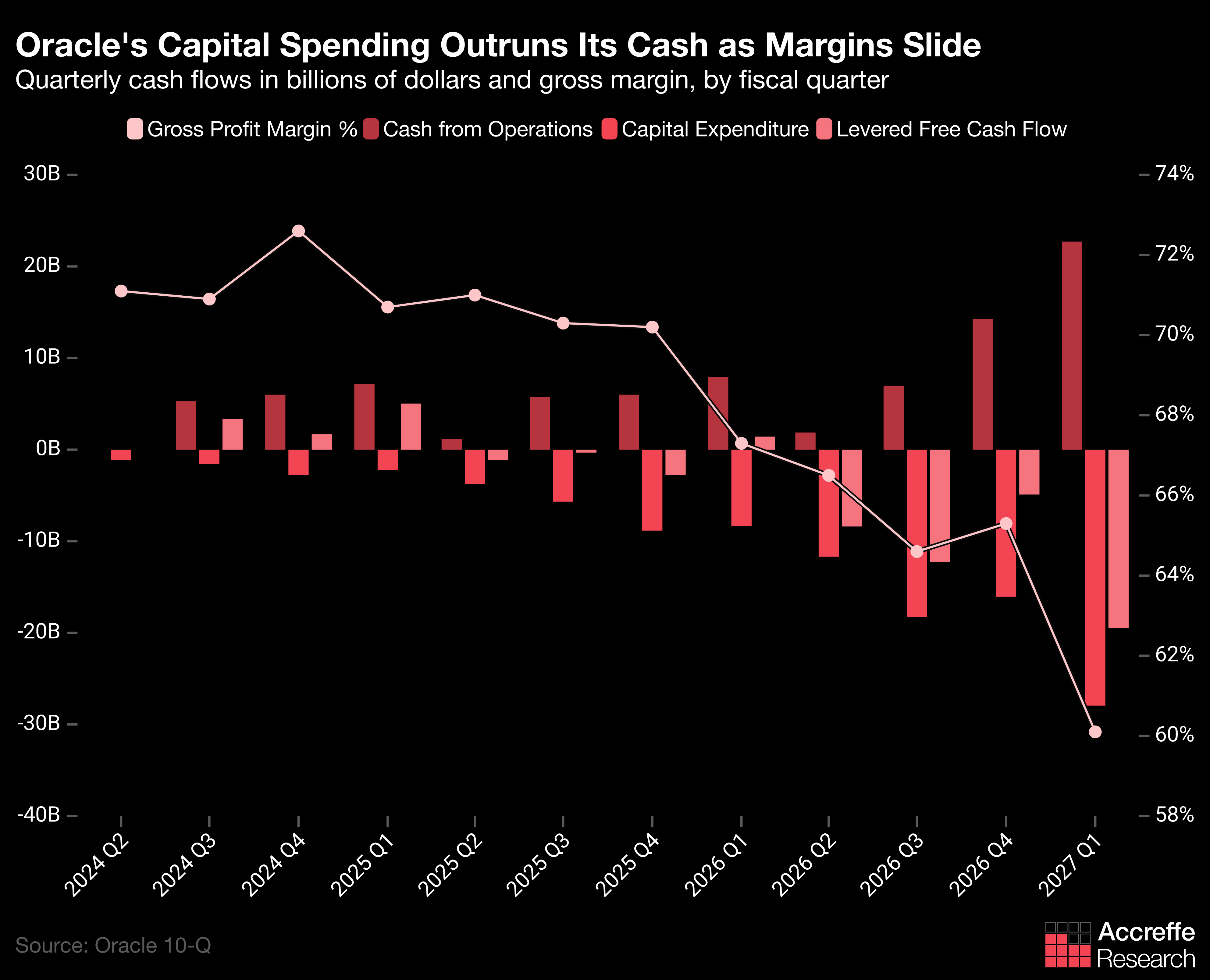
Net of customer prepayments, CapEx was $18 billion for the quarter, and for all of fiscal 2027 the company reaffirmed CapEx in the $90-95 billion range with net CapEx of no more than $70 billion. During the quarter it also fully placed the previously announced $20 billion equity issuance program. The gap between what Oracle spends on construction and what actually comes in as cash from customers is still measured in tens of billions of dollars. That leads to the same split in how the report gets read, into two camps.
Optimists look at the $664 billion RPO backlog and see almost a decade of revenue ahead, backed by the signatures of the biggest tech companies, and most of the quarter’s new contracts came in the form of prepayment or customer-owned hardware, so they won’t require additional capital from Oracle and won’t touch CapEx or revenue before fiscal 2028.
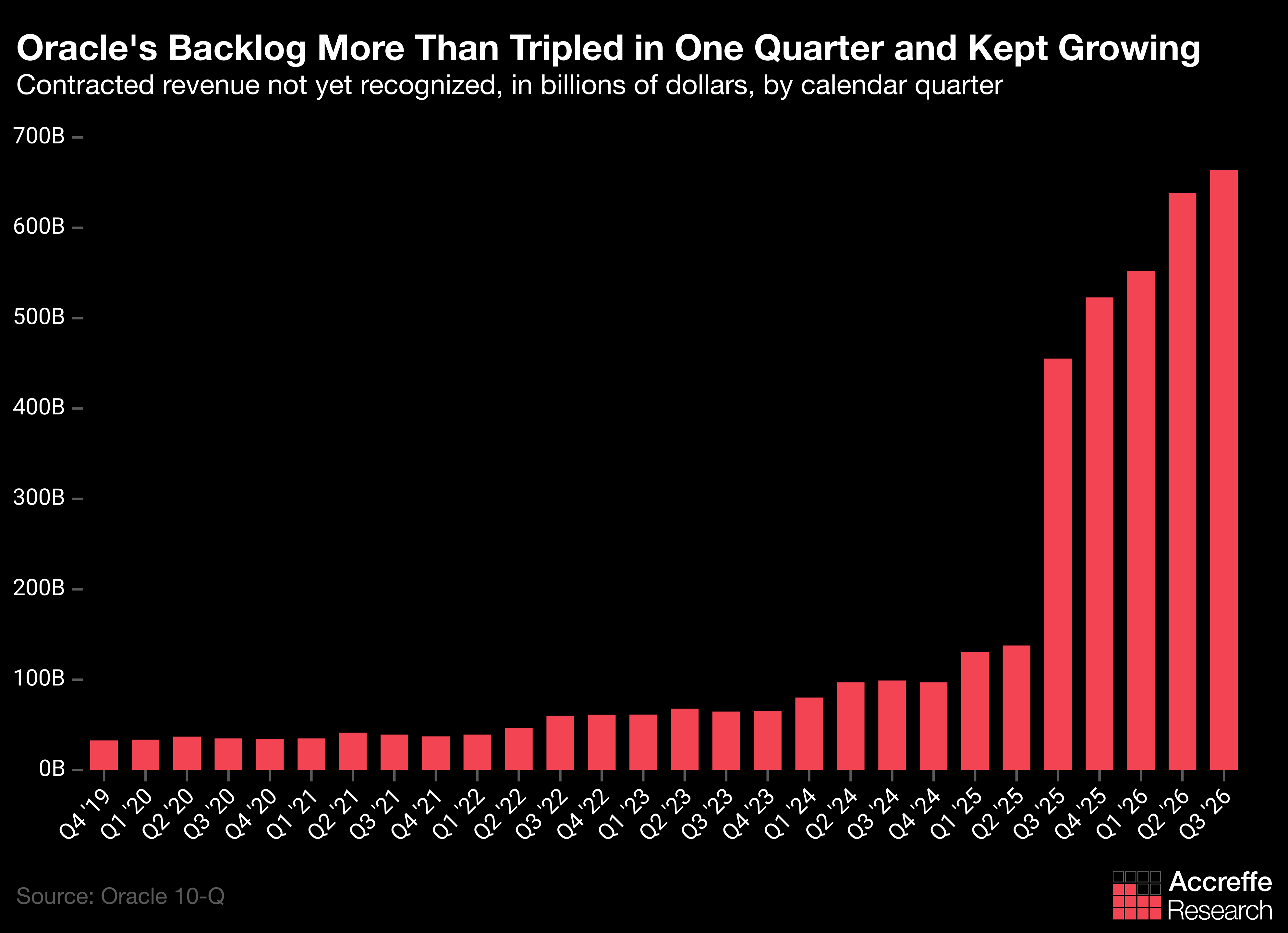
Pessimists look at the same backlog and see concentration risk, because a sizable chunk of it is tied to a single customer, OpenAI, whose own business has never been tested through a full economic cycle, so there’s a risk it won’t have the money to pay for its orders. By various estimates, about half of all RPO is tied to OpenAI one way or another.
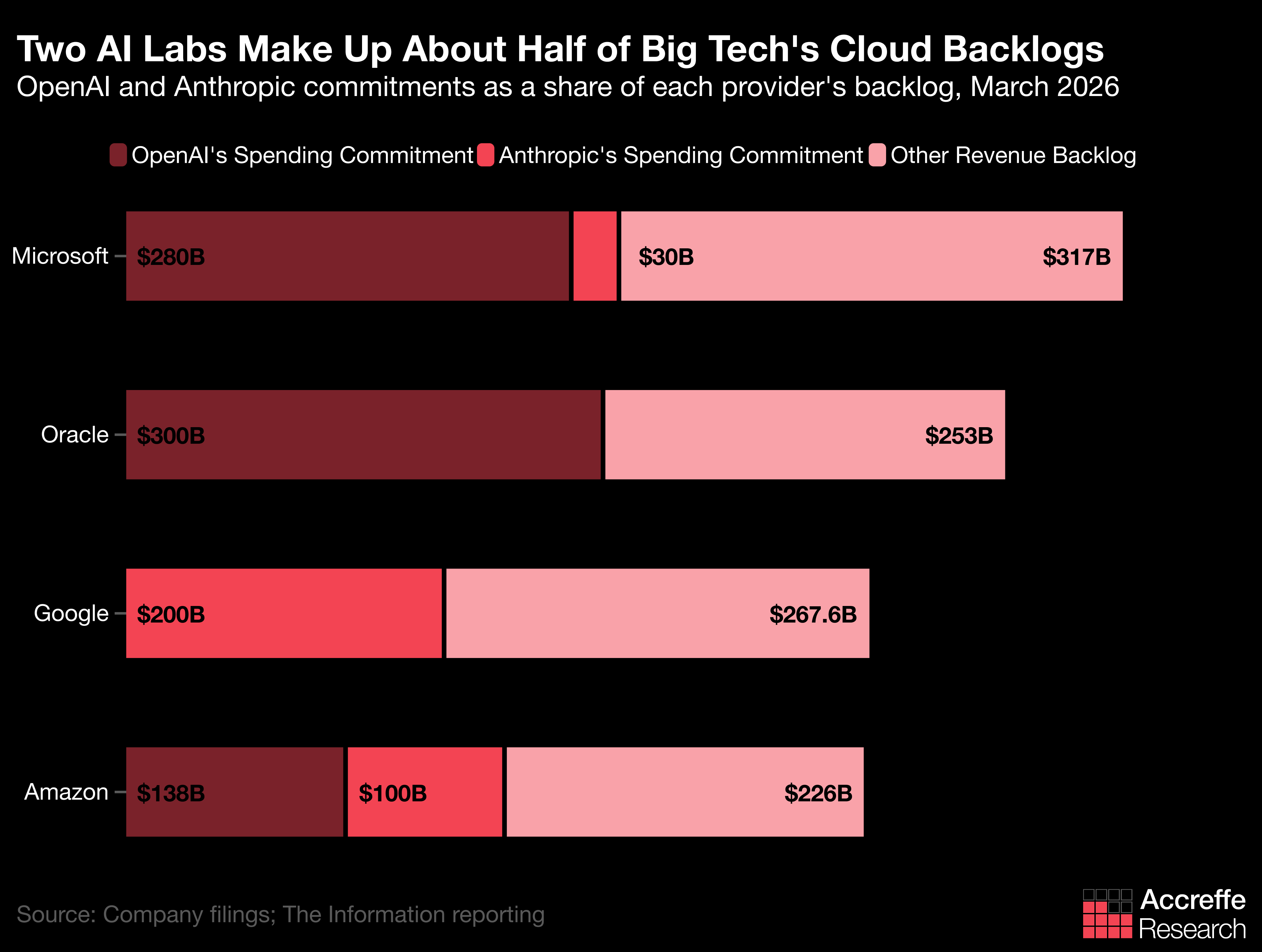
Here the key difference is the probability each side assigns to this backlog turning into real money at all. And last quarter a clear answer to that question appeared, because management said for the first time that it expects roughly half of the entire RPO backlog to convert to revenue already within the next 36 months, versus previous guidance of 12% over the next year and 34% for the period from 1 to 3 years.
I’ll add one more factor here. For the first time in 50 years, two people are running Oracle’s operations at once, Mike Sicilia and Clay Magouyrk, and since last quarter the finance function has been led by a new CFO, Hilary Maxson, who previously worked in capital-intensive industries outside software. That matters, because one of the skeptics’ main arguments against Oracle used to be that the company’s whole strategy rested on one person, founder Larry Ellison, and if he left there would simply be nobody to carry the vision forward, which looks a bit like Elon Musk’s companies and how they’re tied to the founder’s persona. But the appointment of a new operating tandem should dispel that fear. But still, the strategic vision is still largely shaped by Ellison himself, who remains the largest shareholder, chairman of the board and CTO. By the way, the fact that Ellison is still willing to sacrifice his own capital in the short term for long-term profit is, if anything, more reassuring than frightening.
So let’s go down to where the data centers actually get built and these contracts get signed, and try to figure out how bad, or how good, everything is.
The compute factory
A processor can be very powerful, but a model with trillions of parameters gets split across tens of thousands of chips, each one computing its own piece, and then all of them have to exchange results and update the model’s weights. That happens millions of times over the course of training. If data exchange between processors lags even slightly, the chips just sit idle, and it doesn’t matter how powerful they are.
So the OCI Supercluster platform, which can link more than 131,000 GPUs into a single compute cluster with direct high-speed connections, became the very reason Oracle is in the AI race at all. The company developed its Acceleron networking technology to keep chip-to-chip latency minimal.
Judging by last quarter, customers are renewing their contracts partly thanks to how productive this architecture is. Of the GPUs that came up for renewal in the first quarter, all the capacity was renewed or resold at a 20% premium to the old contract terms, and most of those processors are more than four years old. GPU infrastructure utilization, meanwhile, rose to 97.9%. That speaks to the negative thesis that GPUs bought today will be yesterday’s hardware in two or three years and Oracle will have to write them off early. For now, customers are willing to pay more for four-year-old hardware than they paid before, because for the overwhelming majority of inference tasks the previous generation’s power is more than enough.
Deployment speed for new capacity has also climbed noticeably. Last quarter Oracle delivered 850 MW of AI capacity to customers, three times as much as in the entire previous quarter and about 73% of the volume delivered over all of last year. In Abilene, 131,000 GPUs were deployed in the first quarter, almost twice as many as a quarter earlier. Six of the campus’s eight buildings, totaling 618 MW, have now been handed over to the customer, about 75% of the site’s total capacity. Customer acceptance time for new capacity has also shrunk to 24 hours. Incidentally, the latest model, GPT-6 Astra, was already trained on the Abilene capacity. As an addition, one of the most striking recent stories came from META about Muse AI, which is buying colossal amounts of compute from Oracle. And under the agreement, it’s OCI Superclusters that Meta uses. So Oracle’s bottleneck right now isn’t finding customers for new clusters, it’s the physical speed at which this capacity can be built, connected and put to work.
The compute shortage itself is felt not only on Oracle’s side but on the side of the company’s biggest customers too. You may remember how in early September the team building GPT-6 Astra announced it was pausing sales of its $200-a-month plan exactly because those subscriptions put the heaviest load on the system? The API and other plans stayed available, and existing subscribers weren’t affected. So OpenAI, which a sizable part of Oracle’s RPO backlog hinges on, admits the compute shortage itself.
Well, if the chips are in such demand and the line of people wanting to rent compute is that long, who’s paying to build these clusters? Doesn’t this financing model start to look risky in that case?
For years Oracle had to buy all the hardware up front itself, out of its own pocket, without knowing for sure whether customers would want it in the future. Borrowed money, put up the building, bought the chips and earned the investment back through long-term leases of its capacity.
Only now has this model started to change, gradually. In Q1 FY27 Oracle closed more than $30 billion in new AI contracts that required no additional capital from the company itself, and the $26 billion increase in RPO came mostly from prepayment or customer-owned hardware. So part of the risk tied to buying hardware is carried by the customer itself, while Oracle still designs the infrastructure, runs the clusters and keeps them working without interruption.
Meanwhile, the economics of building data centers are changing too. You take after-tax operating profit plus depreciation and divide it by gross capital investment in a particular project. In practice the calculation is done at the level of an individual data center, not the company as a whole, because Oracle has both mature sites that hit full utilization long ago and new ones that are still signing up customers. And if you average the return across the whole company, mature projects distort the picture for new ones, and vice versa.
In the phase when a project reaches full revenue utilization, the return holds around the high 20s percent a year, not counting a possible further increase in returns (if the GPUs last longer than planned). In contracts with prepayment or with hardware supplied by the customer, the return is higher, because Oracle puts in less of its own capital at the start of the project while the operating margin for managing and servicing the cluster stays the same. A smaller denominator with the same numerator gives a higher result, and the more customers sign contracts with prepayment or their own hardware, the less Oracle has to borrow for each new data center while keeping the same pace of capacity growth.
Neutral compute
We all know a country that stays neutral territory, where, as happens in our world, the sides of various conflicts bring their money because they trust its banks. That kind of neutrality is an asset in itself.
In AI cloud infrastructure, Oracle has taken a similar position. Amazon, Google and Microsoft, alongside buying GPUs from Nvidia, are building their own competing chips to reduce dependence on a single supplier. Oracle has no such competing program: it’s a pure buyer of Nvidia GPUs without being its competitor. On one hand, that looks like a weakness, but in practice it’s supply predictability, because Nvidia doesn’t have to split its scarcest chips between a buyer and someone trying to replace its own products with an in-house design. This quarter the company also announced first deliveries of systems on Nvidia’s new Vera Rubin generation to customers already in the second quarter, and according to management these systems are beating expectations on hardware quality. So by staying out of the fight over chip development, Oracle is on the priority list for deliveries of the most advanced chips.
The same logic applies at the level of AI models. Oracle expanded its partnership with OpenAI, adding access to the API, ChatGPT for business and Codex through its marketplace, including the new GPT-6 Astra model. At the same time, the company started offering Gemini models inside its enterprise applications, released new Grok models for reasoning, multimodal tasks and speech synthesis, and kept expanding its catalog of open models, including ones from Nvidia, Qwen, Google and DeepSeek. The company isn’t trying to compete at the level of the large language models themselves, it keeps itself as the compute and distribution provider for everyone at once, making money regardless of which lab wins the model race. The main thing is that demand for compute remains.
Also, Oracle keeps expanding its work with both Azure and AWS. Its database is now available in 70 multicloud regions and 119 zones. And Oracle’s multicloud database revenue grew 353% over the year, with the number of customers up 180%. Oracle has also launched the Oracle Interconnect for AWS service. It lets customers connect Oracle databases directly and quickly to AWS, as well as to other major cloud platforms. Customers don’t have to pay for data transfer between clouds, and a customer can keep using AWS or Azure for its core workloads while using the Oracle database. Moving data between clouds becomes simpler and cheaper for the customer. So Oracle can make money on its databases even when a customer picks AWS or Azure as its primary cloud provider.
Neutrality of this kind almost always works only for a player that isn’t going for first place itself. If Oracle tried to sell neutral compute and at the same time build its own model competing with customers of its own cloud, trust would collapse instantly, roughly as if a Swiss bank took one side of a conflict whose money it holds, or became a separate military force altogether. Giving up its own model and its own chip costs the company potential margin in a narrow segment, but gets it access to the whole market in return.
Looking at it more broadly, if data and compute can be moved between different clouds relatively easily, why wouldn’t governments and large companies just pick the best deal every time? But in practice it’s more complicated. For a government or a big corporation, what matters isn’t only who can technically process the data, but also who has access to it, and where exactly that data sits and under whose jurisdiction. If you compare it with precious metals, most countries prefer to keep their gold reserves on their own soil, because during a crisis, a conflict or a sharp shift in international relations, access to assets physically located abroad can come under threat. The exact same logic applies to data and AI compute infrastructure, because it’s an all-encompassing asset that touches every area of how a modern state functions.
This concept got the name sovereign AI: governments having the ability to deploy fully functional infrastructure inside their own jurisdiction, under their own laws on data storage and processing. Oracle management confirmed in Q1 FY27 that the Alloy business (the sovereign and local cloud partner program) is growing, partly thanks to partners in Japan and the Middle East, and some of that demand is tied directly to AI, because many of these partners get access to GPU capacity for sovereign workloads in particular. The same portability of the technology makes it possible to deploy a full version of its cloud platform, including the database and the whole application suite, in a configuration of just twelve server racks, and eventually even six. That can physically go inside a customer’s existing building, an old bank data center, for example.
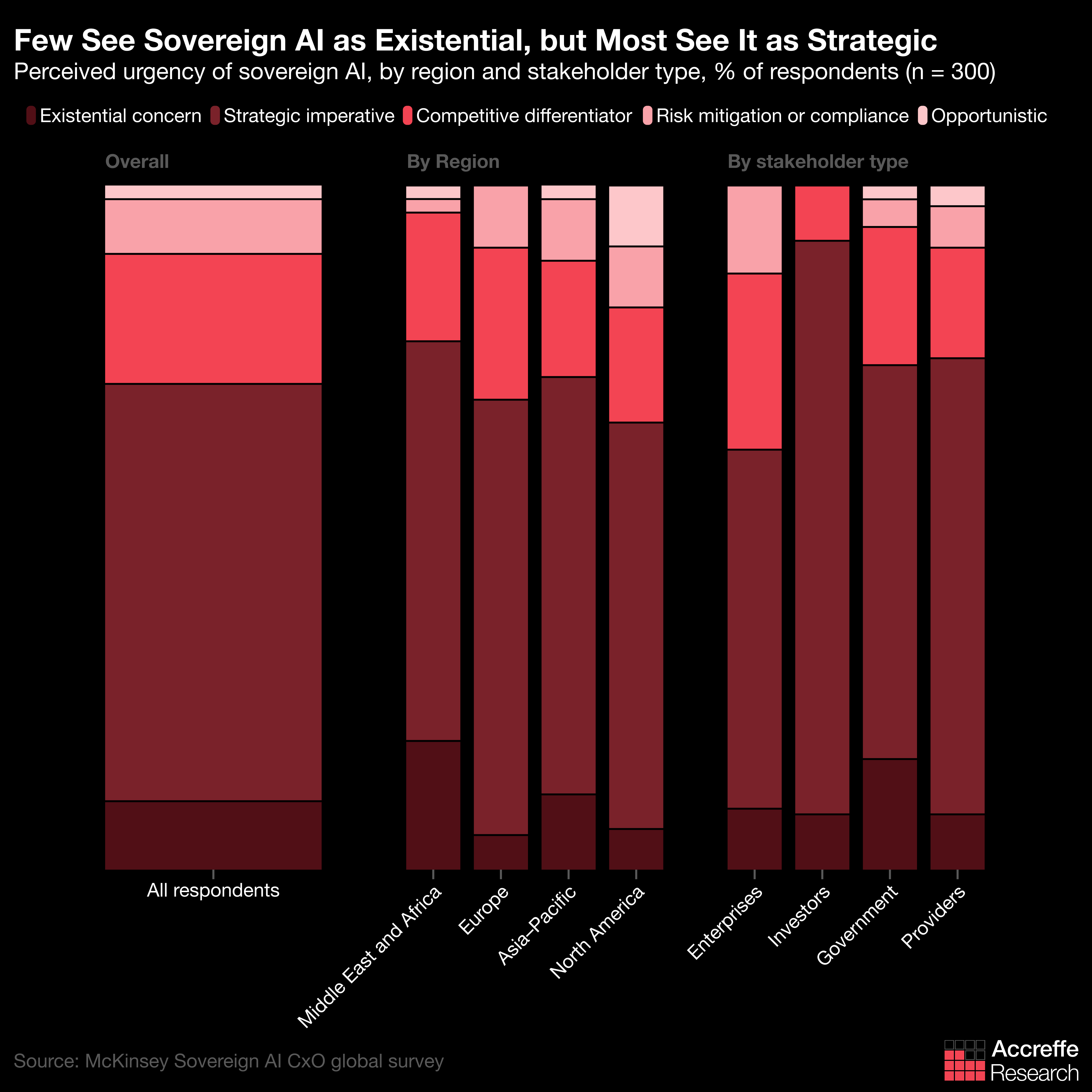
By McKinsey’s estimates, 71% of executives and investors describe sovereign AI as an “existential concern” or a “strategic imperative.” So for most of them it’s a factor that directly affects whether their organizations reach their goals.
In parallel, Oracle keeps building larger data centers. But projects like these need a colossal amount of energy and infrastructure, and that has become the company’s Achilles’ heel. Despite management’s upbeat exclamations about the steady development of the sites in Wisconsin and New Mexico, in response to journalists’ questions, the situation turned out to be somewhat worse. But at the same time, none of these sites supplied the capacity Oracle brought online in the first quarter, so delays at individual sites don’t mean the whole construction program has stopped. Oracle spreads construction across a large number of sites and reduces its dependence on any one project. But the more you learn about the two problem campuses, the less reassuring this argument is.
First and foremost, Project Jupiter drew attention. Management said its launch could slip by about six months, into 2027. On September 24 Oracle sent a force majeure notice on the project, citing a delay in building a gas pipeline and a pending air emissions permit. The project includes a campus in New Mexico, where Oracle is still going through the procedures tied to the emissions permit. To power the site, the plan is to use Bloom Energy fuel cells (a company whose stock was not long ago bought by the famed Nancy Pelosi).
Because of the delays and the uncertainty around the project, banks started assessing more cautiously the roughly $18 billion in loans made against the campus in Doña Ana County. On the secondary market they’re now trading at about $0.89-0.91 on the dollar. That doesn’t mean the market thinks the data center itself is junk. More likely, investors have started putting a higher price on the risks tied to launch timing, financing and Oracle’s own financial position. An attempt to sell part of this debt to other investors ran into trouble, and the banks had to keep more of the loans than they’d planned. Oracle’s credit rating adds more pressure, since after the downgrade the company sits just one notch above speculative grade. So investors demand a higher risk premium, and that shows up in the price of the debt.
But the project itself really does have a power supply problem. The campus needs a significant amount of electricity, and the necessary infrastructure, including the gas pipeline, has run into delays and regulatory obstacles. What investors care about now isn’t whether the campus gets built, but when it can fully start running and how much getting it going will cost. Effectively, the loan price shows the market is pricing extra risk into the timeline, the financing and Oracle’s ability to get power to the campus on time.
In September the permit situation improved slightly, as the New Mexico Supreme Court rejected two complaints from environmental groups, which let the administrative process continue. But the date of a new hearing on the emissions permit is still unknown, since the official who handled the process has left the post and a replacement hasn’t been appointed yet. So the regulatory uncertainty hasn’t gone away.
On top of everything, there’s a political factor too. New Mexico gubernatorial candidate Deb Haaland has said that if elected she’ll impose a moratorium on new large data center projects until the state sets clearer rules for the industry. Project Jupiter, judging by the stated terms, doesn’t fall under that moratorium. At the same time, I want to point out that Haaland herself received about $87,000 for her campaign from companies and executives connected to the project. Some of the money came from Oracle, some from executives at Clayco, which is building the campus. The outcome of the election isn’t known in advance, so it makes sense to keep an eye on this factor.
In Wisconsin, too, things turned out less favorable than they’d seemed before. Oracle had been counting on starting to deliver capacity from the Port Washington campus in the second half of 2027, but on September 30 the independent analytics firm Aterio published a breakdown of Project Lighthouse, which Vantage Data Centers is building for Oracle. Based on filings submitted to regulators through September 24, Aterio sees substantial risk that this timeline won’t hold, and significant load is unlikely to start before mid-2028. Vantage itself expects the whole campus to be finished by 2028. What’s also important is that Lighthouse, with an IT load of about 900 MW, is comparable in scale to the capacity Oracle brought online last quarter. This isn’t some small site anymore whose delay goes unnoticed.
I want to point out that the problem isn’t construction itself, since that’s moving along. Permits are in place, work has been going on continuously since December 2025, and satellite imagery shows two of the four buildings are already enclosed. But the constraint is the power grid, since the campus can’t operate until American Transmission Company builds a new high-voltage line, and work can’t start without approval from the state Public Service Commission. ATC’s first application was under review for ten months, after which, in August, the state Public Service Commission revoked its finding that the application was complete and closed the case, citing hundreds of changes to the project’s scope made after filing. In September ATC refiled, and the statutory clock started over.
Aterio models three scenarios depending on when the state Public Service Commission issues its written order.
In the earliest legally possible case, partial power delivery will start in October 2027 and the full 1.3 GW will be reached around August 2028, but that’s unlikely, since no comparable case in Wisconsin has moved that fast. In the base scenario, with a decision in 180 days, partial power will start around December 2027, full power around October 2028, and growth in customer load will begin mostly from the first quarter of 2028. If, on the other hand, the commission uses its right to extend the deadline up to 360 days, as it did in every comparable large case Aterio reviewed, partial power arrives around June 2028 and full power in April 2029. I’ll note that Aterio doesn’t trade Oracle securities and calls all these dates its own estimates, not commitments from ATC, PSC, Vantage or Oracle, so actual timing could differ a lot. The nearest marker for Wisconsin is the state Public Service Commission’s decision on the completeness of the application, around October 19, 2026. Around the same time, ATC is supposed to file a request with grid operator MISO to install voltage stabilization equipment near the campus substation.
The delays in New Mexico and Wisconsin still don’t mean Oracle’s construction program has stopped. But at two large sites the company is running into the same problem of power supply and regulatory procedures. So many people are questioning timelines even where everything used to look ironclad. Yes, diversification across sites reduces risk, but it stops being the main argument that the schedule will be delivered.
In effect, Oracle is now developing two different types of infrastructure. The first: huge multi-gigawatt data centers meant primarily for the largest AI workloads. They need enormous amounts of energy, their own power infrastructure and complex permits. The second: more compact setups that can be placed closer to a particular customer or directly inside the country that needs them. They don’t require building a giant campus, so they make the news much less often.
It’s the second option that’s especially important for the sovereign AI market. Governments don’t always need a huge multi-gigawatt data center. It may matter more to them to have compute infrastructure inside their own jurisdiction, so they can control data and comply with local requirements. So for Oracle this is potentially a separate source of growth. The company can build huge American data centers for its biggest AI customers and at the same time sell more compact infrastructure to governments that care about control over their data and independence from foreign clouds.
By McKinsey’s estimate, the sovereign AI market could grow to $600 billion by 2030. Meanwhile, only about 30 countries today have compute infrastructure capable of supporting the most complex AI tasks. If this market really does develop quickly, Oracle will be able to make money not only on building giant data centers but also on spreading more compact solutions around the world.
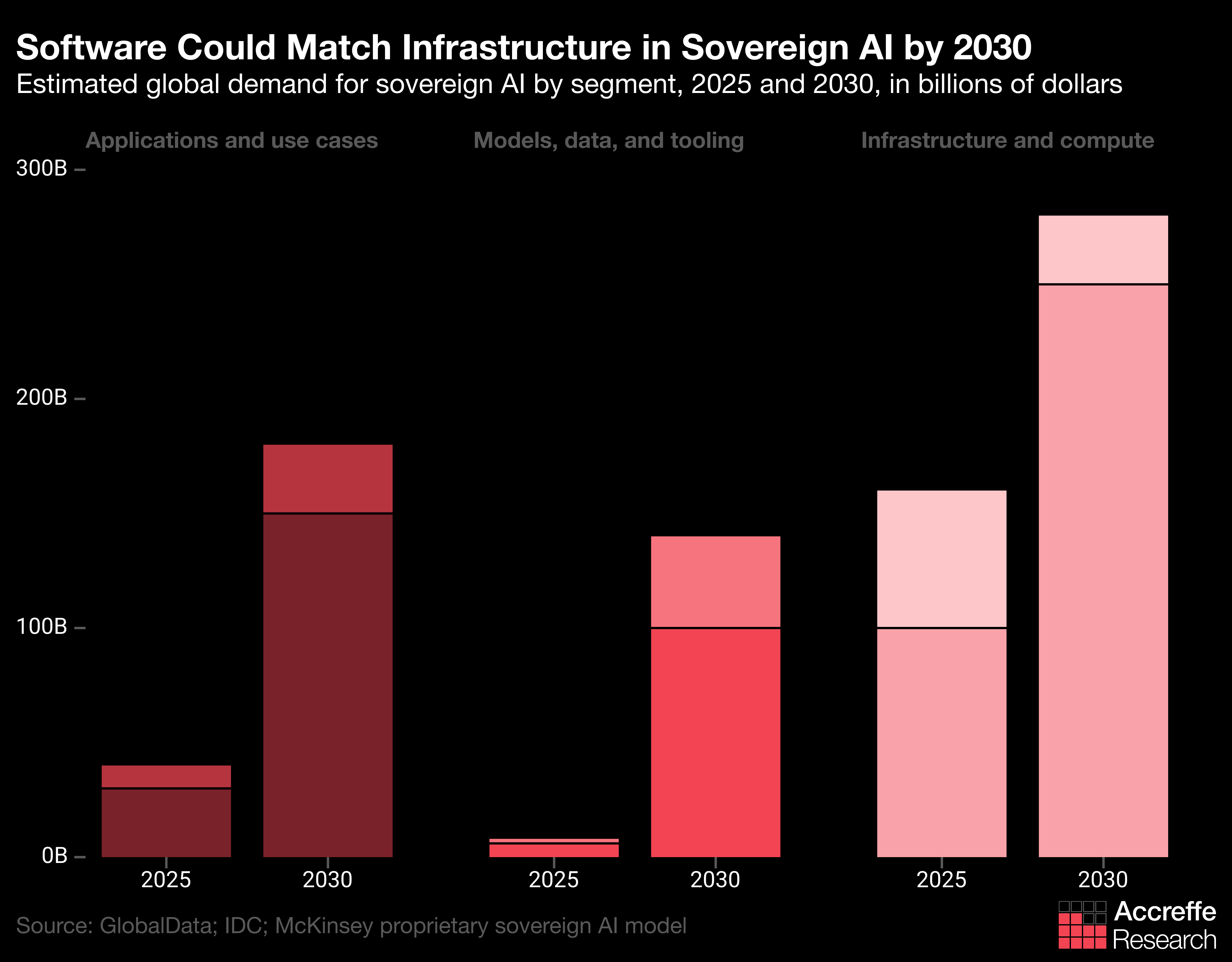
So it turns out the bulk of the growth is still ahead, not realized.
But as I’ve written in previous articles, the main value of AI for business lies in the data it works with. Every company has its own data on customers, operations, employees and processes that competitors don’t have. That’s why Oracle is trying to take the spot between this data and AI, so a company can use its data in AI work without losing control of it.
Here, of course, security matters too. For example, after buying Cerner, Oracle became one of the largest providers of electronic health record systems in the US. In these systems each patient gets a separate encryption key, rather than one key for the entire database. That limits the fallout from a possible attack. Put differently, Oracle doesn’t just store data, it builds protection around it that should make it possible to use that data together with AI.
The same logic is behind the Oracle AI Data Platform. In the first quarter Oracle integrated it with Codex and Claude Code so developers can use enterprise data through the tools they’re used to. The platform can pull together data from hundreds of sources and link it into a single system, even if some of that data isn’t stored in Oracle. That matters because AI becomes much more useful when it can work not with a single database but with all the data a company needs. Then Oracle adds tools that let AI work with that data according to the company’s rules, the way, for example, AI Agent Memory helps agents keep information about past actions and use it later on. Deep Data Security limits what data employees, and AI agents acting on their behalf, can see. Oracle is trying to gather data from different sources, give models access to it, preserve the working context and control access at the same time.
So data and applications could become an important part of Oracle’s advantage in AI. This company doesn’t need to build the best model. If the data and applications a business needs for AI run through its systems, Oracle’s infrastructure itself becomes part of that system. But this advantage rests not on one business but on two at once, which are growing for different reasons and at different speeds, since Oracle’s revenue structure consists of two sources that are practically independent of each other.
OCI cloud infrastructure is growing at an explosive pace. But alongside it there’s cloud revenue from applications, Fusion for finance and HR, NetSuite for midsize businesses, industry solutions for healthcare and the public sector, where total revenue rose 10%, with Fusion up 14%, industry applications accelerating to above 20%, and the Oracle Health business continuing to accelerate. NetSuite grew more slowly because of longer customer decision cycles last year, but this very quarter the company introduced NetSuite Next, a new generation of the product built around an agentic user experience, and the accompanying AI Connector Service, which lets customers securely connect NetSuite data to outside AI assistants like ChatGPT and Claude, is already used by more than 10,000 customers, making it the fastest-adopted feature in the product’s history.
Customer requests to built-in AI capabilities rose to more than 150 million a quarter (up 42% quarter over quarter), and the AI agents themselves were used in real workflows more than 3.5 million times, twice as often as a quarter earlier. The number of AI agents already running at customers in real business processes passed 2,300, up 90% over the quarter. The quarter’s list of customer cases also got a noticeable refresh. Uber, Stanford University and Mitsubishi UFJ Bank launched or expanded their use of Fusion. Pye-Barker Fire & Safety chose the full suite of Oracle applications, including Fusion agentic applications. Johnson Controls, Saudi National Bank, GuideWell Mutual Holding Corporation, which serves more than 45 million people, and Malaysia’s national energy company PETRONAS added Fusion agentic applications this quarter.
When customer commitments grow faster than the money already received from them, it usually means new contracts are being signed for longer terms and renewed rather than cut back. At the same time, over the past year Oracle has become more flexible about how it sells AI. Basic AI features in Fusion, NetSuite and industry applications are mostly included in the regular subscription at no extra charge. But if a customer needs more powerful models or more compute, it can buy additional token packs that can be used across different Oracle products. Meanwhile, the company is increasingly tying the price of AI to a concrete outcome. Oracle is gradually moving away from the simple “pay per user” model and starting to charge for actual AI usage or the result it delivers.
This matters against the backdrop of one of the main problems AI creates for enterprise software makers. If an AI agent fully replaces an employee who used to use the software, the developer risks losing a paid subscription. Oracle is trying to build an alternative model. If AI helps a customer get more value from a system it already uses, the customer may pay Oracle more, not less. And the extra charge may depend not on headcount but on the amount of work AI does, or on the result of that work. Meanwhile, the company embeds AI into its own products, which tens of thousands of enterprise customers use. So even if the big labs someday cut spending on renting compute, Oracle still has a second growth channel tied to bringing AI into existing enterprise software. And vice versa, high demand from AI labs lets the company make money on compute growth even before AI fully penetrates its own applications.
So it turns out the first revenue source is tied to growing compute demand from the largest AI companies. The second comes from Oracle adding AI to its existing products and earning extra revenue from its own enterprise customers. The only question is how significant these two directions are for an investor’s potential profit.
Relative valuation and multiples
Is the company expensive right now, and what does it even make sense to compare it to? Let’s start with the forward P/E, which for Oracle sits at 16.47x, while the company’s own five-year average is about 33x.
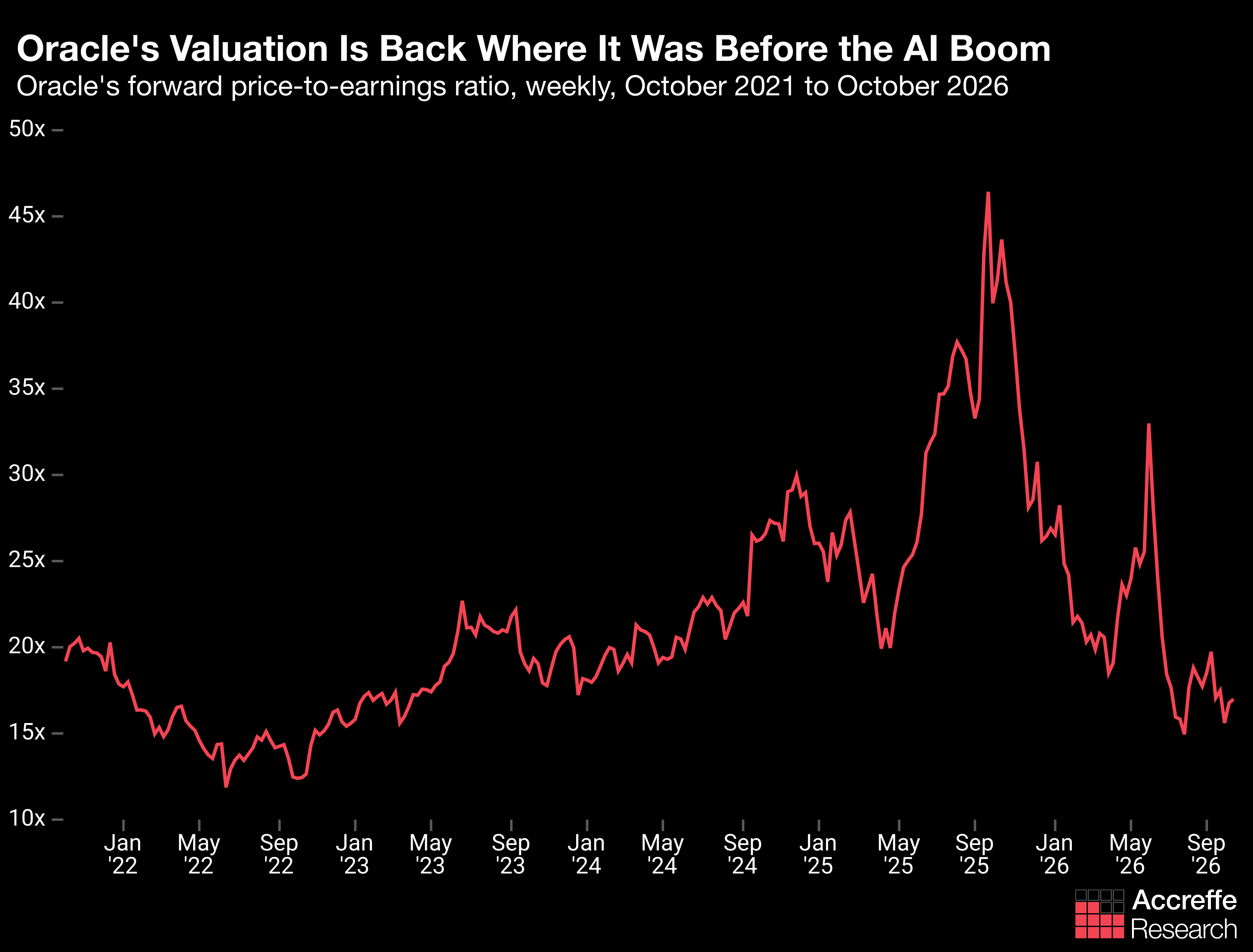
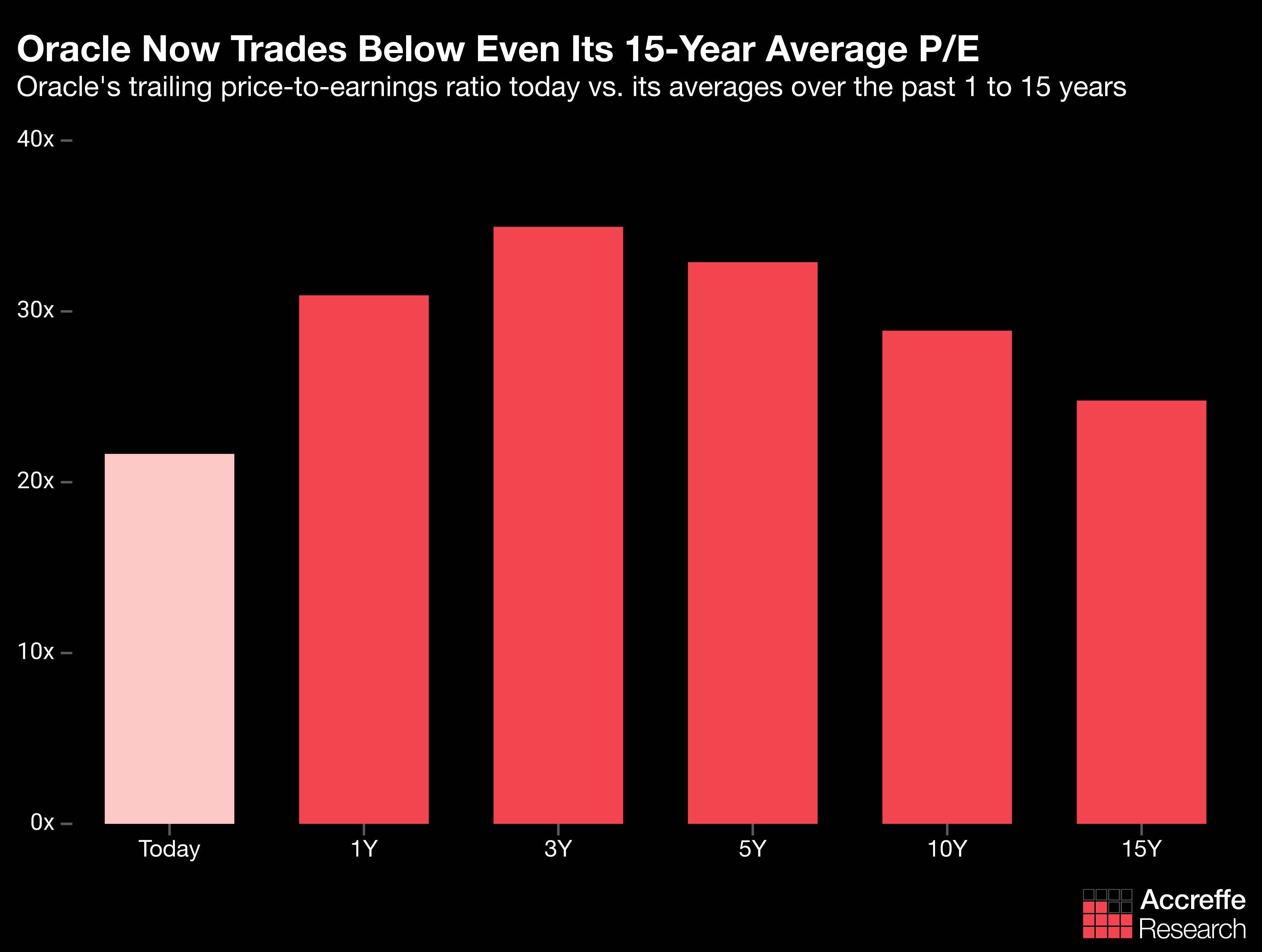
So right now the market is paying noticeably less for Oracle’s future earnings than it paid on average over the last 3-15 years, even though revenue and backlog growth rates are higher now than the average over the same period. After the full-year revenue and EPS guidance was raised following the first quarter, this gap between growth rate and multiple became even more noticeable, but it isn’t proof of undervaluation, because a lower multiple can reflect increased risk, not just an increased discount.
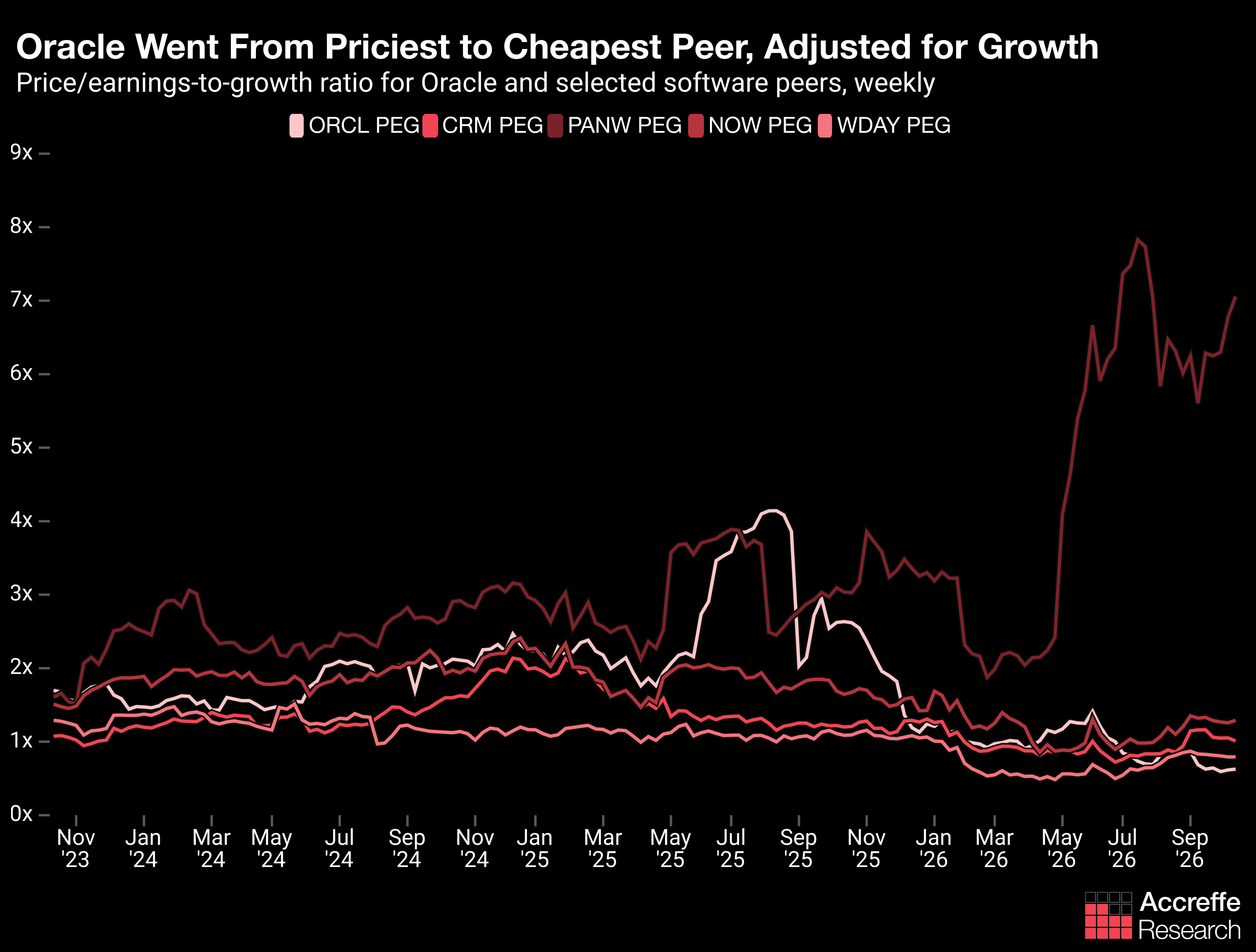
Take the PEG ratio too, for more detail. For Oracle it’s about 0.66x. By comparison, Salesforce is around 1.10x, ServiceNow about 1.32x and Palo Alto Networks about 6.3x. Even among enterprise software companies of comparable scale, the market values Oracle far more cheaply relative to its own growth rate than its direct sector neighbors.
There’s also a more technical check on the same question: decomposing the stock’s price move into components, breaking a single stock’s price change into the contribution of the broad market as a whole, the contribution of the tech sector, the contribution of the narrower enterprise and cloud software industry, and the idiosyncratic part of the move that’s specific to this particular company.
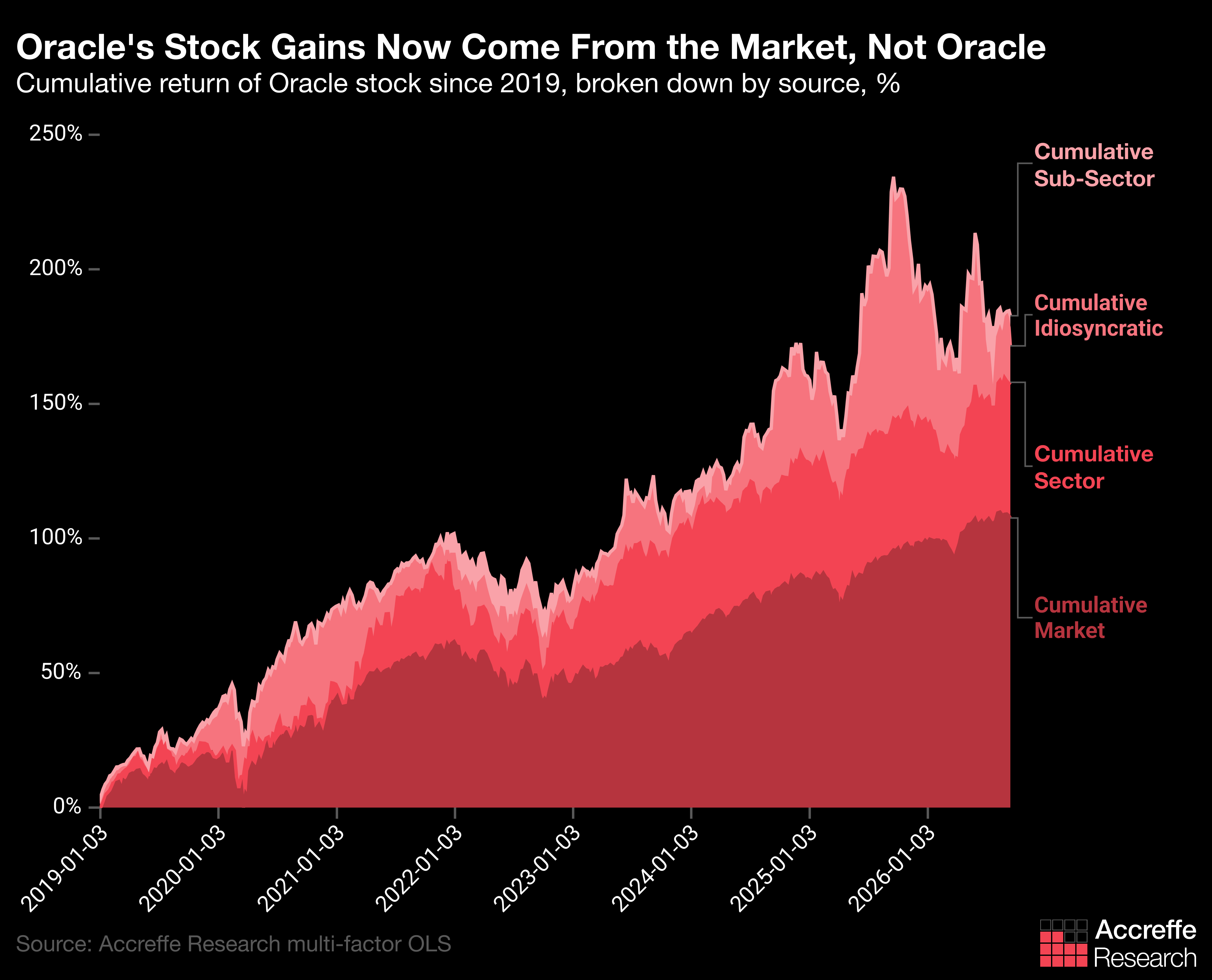
A significant share of recent price moves comes down to the idiosyncratic factor: a reaction to the company’s own news rather than to a general rise or fall in the tech sector. Idiosyncratic volatility in both directions means market participants still haven’t settled on a single valuation model for the company, not that the fair price has already been found.
Just as important is the credit side of the question, because earnings multiples say nothing about how resilient the company’s balance sheet is with this much construction going on. Oracle’s credit rating holds at investment-grade BBB, but with a negative outlook from the rating agencies, and net debt to EBITDA is around 4.2x.
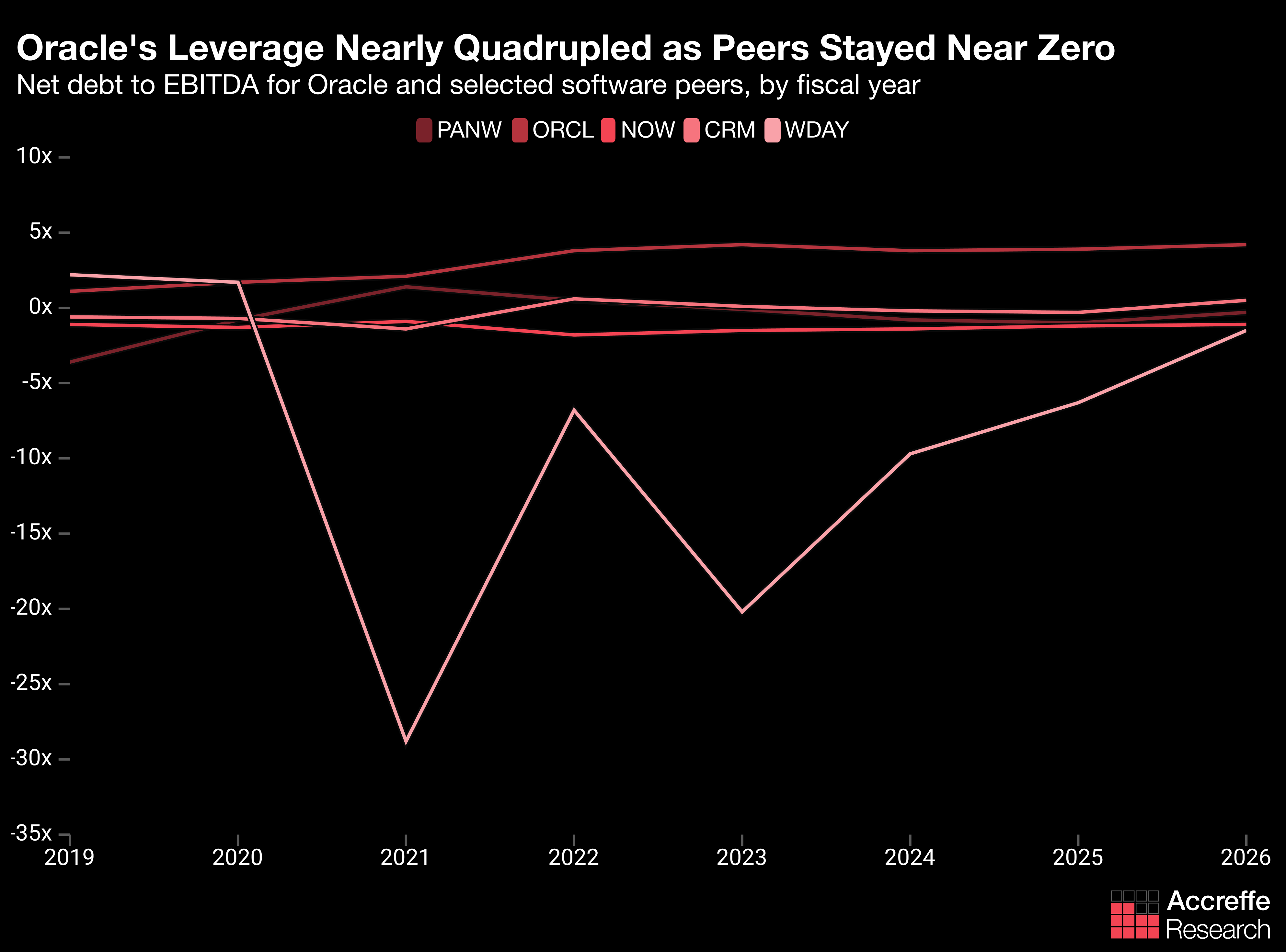
Meanwhile, interest coverage from operating income is 5x.
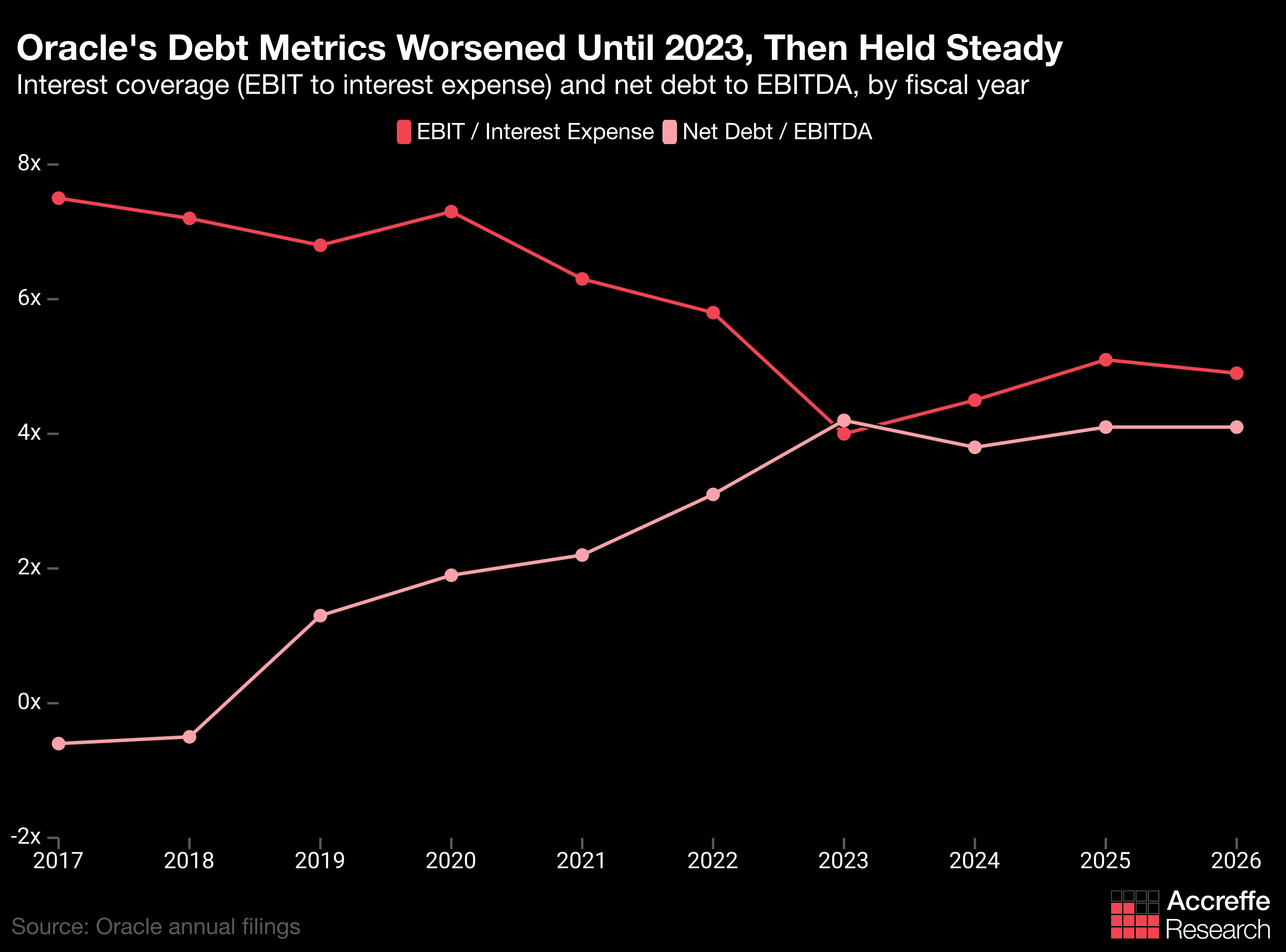
These numbers aren’t a catastrophe, but they’re higher than at most comparable software companies, whose net debt is usually negative altogether.
The difference is that Oracle right now is only a high-margin software company, but also an infrastructure developer, and these two types of business are usually valued on different multiples and with different debt loads. If you look at the company as a pure enterprise software vendor, its current multiple looks too low relative to its growth and relative to peers like Salesforce. If you look at it as a hybrid of a software company and a data center developer, part of the current discount to its historical multiple looks like a logical price for higher debt and a more capital-intensive growth model.
Fair value lies between these two extremes, which is exactly why we’ll move from ready-made multiples to a DCF model of the company under different scenarios.
Three scenarios
The fair value of a company running one mature and one fast-growing, capital-intensive business at the same time depends on variations of scenarios, any of which could play out, and on how much weight is assigned to each of them.
Below is the scenario model:
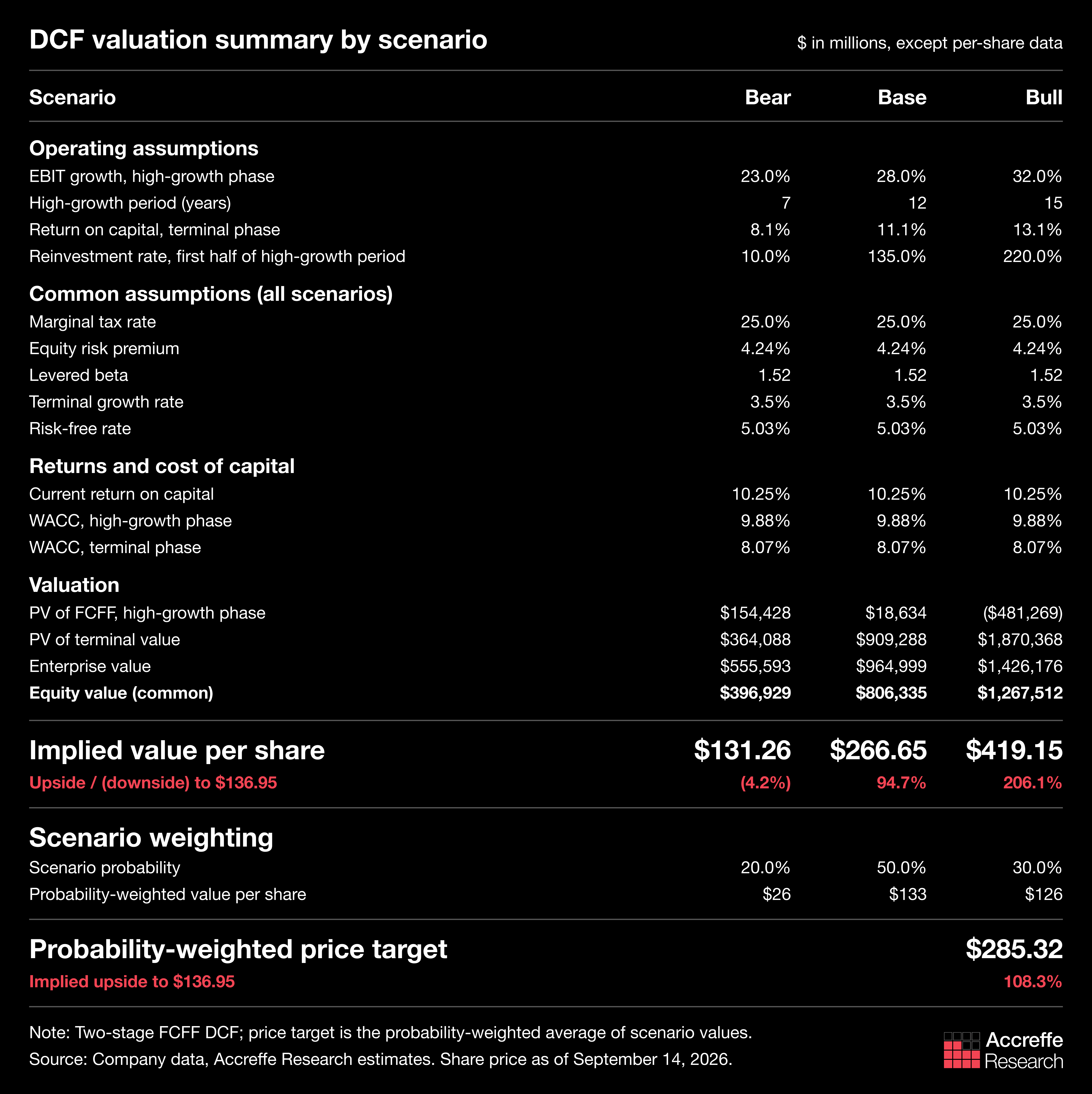
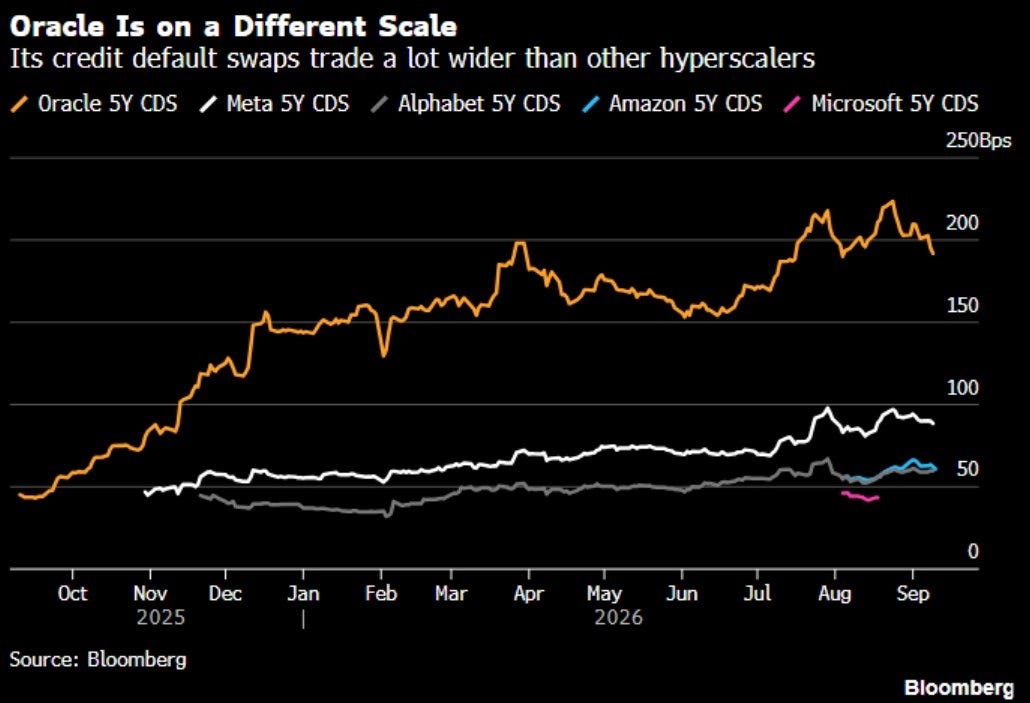
In the Bear scenario, the assumption is that the compute shortage turns out to be a temporary and cyclical phenomenon rather than a fundamental shift. Hyperscalers slow their CapEx commitments sooner than expected, and part of the RPO gets renegotiated, where concentration risk on OpenAI is key. Any doubts about OpenAI’s ability to fund its contracted volumes tie directly to a reduction in Oracle’s backlog. At the same time, financing conditions tighten, since the agencies already downgraded Oracle to BBB- in mid-2026, and by September the rating outlook had changed from stable to negative, accompanied by the CDS spread widening to a multiyear high:
Force majeure on Jupiter, the Doña Ana debt repricing, Lighthouse delayed to 2028-2029: I’ve already described all of that. Rising interest rates make debt financing for new data centers even more expensive on top of an already rising risk premium, and in that case Oracle earns roughly what investors demand for the risk. I put the probability of this scenario at up to 20%, because some of its premises aren’t hypothetical, but it still requires OpenAI’s very ability to pay on its contracts to come into question, not just individual construction projects falling behind schedule.
The Base scenario is the most likely, because it continues the trajectory already confirmed in Q1 FY2027. Cloud infrastructure will keep growing above 100% quarter after quarter, the RPO backlog will keep converting into revenue, and the company will move toward its own target of $225 billion in revenue by fiscal 2030, which it announced at Investor Day in October 2025. The delays at Jupiter and Lighthouse push back the launch of those two sites in particular, but Oracle spreads construction across a much larger number of projects, so in the base scenario this remains a timing risk at individual sites rather than a revision of the trajectory itself. The 50% weight reflects that it’s the path of least resistance, since Oracle doesn’t need to do anything radically new for the scenario to play out, it just needs to keep doing the same thing it’s done in recent quarters. It’s also important that management, in the last reported quarter, didn’t just hit its own forecast but raised full-year guidance after the first quarter, eclipsing seasonality. That’s why I don’t give the base scenario a weight above 50% and leave a slightly higher probability for the more optimistic scenario.
The Bull scenario plays out if the AI compute shortage turns out to be a structural and long-lasting phenomenon, and Oracle’s position as a neutral compute provider turns out to be more valuable than the market is pricing in now. If GPU infrastructure utilization stays close to the 97.9% recorded in Q1 FY27, and contract renewals keep coming at a premium to previous terms, that will mean the hardware’s physical service life is more durable than the current depreciation model assumes, and the business model is sturdier than it looks. If sovereign AI and retail monetization of embedded AI inside enterprise applications start contributing not only to growth rates but to margin, the company will move beyond the story of hyperscale data center CapEx. I put this scenario’s probability at 30%. Yes, that’s significant, but not the lion’s share, because the scenario requires several independent growth drivers to work at once, not separately.
If you weight these three scenarios by probability, the probability-weighted fair price comes out around $285 a share. Most of the probability mass sits in the scenario where Oracle simply keeps executing the trajectory already confirmed in Q1 FY27, so the company’s ability to confirm this trajectory quarter after quarter will determine which way this probability picture shifts over the next two or three years. Just as important remains the update to the long-term target at Investor Day in October 2026.
Risks that didn’t go away with growth
First, and most obvious, is the risk around debt load. The company’s credit rating holds at investment grade, but with a negative outlook, and net debt to EBITDA is around 4.16x. To fund its fiscal 2027 capital spending program, Oracle has already fully placed its $20 billion equity issuance program and confirmed a plan to raise around $40 billion in capital, though management does stress that no additional debt beyond what’s already been announced is planned for calendar 2026. As long as market participants believe in AI’s prospects, raising money at a reasonable rate isn’t hard. But if investor sentiment shifts or interest rates rise noticeably (given the Fed’s change in rhetoric), borrowing costs could jump faster than the company can grow earnings to a comfortable debt level, and this sensitivity remains the main factor from the bear scenario in the previous section.
Second, the risk lies in customer concentration. Just four customers contracted more than $8 billion in a single quarter, back in the previous reporting period, and about half of the entire RPO backlog is tied one way or another to one company, OpenAI. That’s what one of the skeptics’ main arguments is built on, including the well-known hedge fund manager Michael Burry, who publicly called the company’s entire contracted backlog an unsecured liability, because the risk, by his logic, lies not in Oracle’s ability to build data centers but in OpenAI’s ability to actually pay for what it contracted. The bull side’s counterargument goes like this: even if you value the entire order backlog at a notional zero, any real conversion of it into cash becomes pure upside, and OpenAI’s latest $122 billion funding round, the largest in the history of venture financing, is more likely to lower than raise the odds that the bills go unpaid. Somewhat similar logic already played out in February 2026, when Oracle announced plans to raise up to $50 billion in debt and equity for its data centers, its five-year CDS fell 17%. Market participants read access to capital (including counterparties’ ability to fund themselves) as a lower probability of default. As long as companies can raise money, the AI supercycle isn’t over.
Third, the risk is tied to competition for the same compute capacity. On investor calls management is regularly asked about the growing number of new players in the AI data center market. Management’s answer boils down to this: demand has exceeded supply many times over for several years running, which is why the company is able to raise prices on renewals. That argument holds during today’s acute capacity shortage, but it’ll 100% weaken if compute supply at some point starts catching up with demand.
Fourth, the risk lies in healthcare: Oracle has been losing market share for years to rival Epic Systems among large hospital networks. The contract with the US Department of Veterans Affairs remains a large and stable source of revenue, and the Oracle Health business accelerated last quarter, but growth in this area still rests mainly on government contracts, not commercial ones.
Fifth, the risk is the most general one, and it concerns the very nature of the speculative capital now going into AI infrastructure. Suppose the pace of AI adoption in the real economy turns out slower than investors expect, or progress in the quality of the models themselves slows down. In that case, companies that are aggressively renting compute today for future growth may start revisiting order volumes, and the whole chain from chips to data centers will feel it first through cancellations or freezes of new contracts, which directly undermines both RPO growth and the premises of the base scenario.
Sixth, the risk concerns regulation, along with the physical speed of construction itself. Building data centers at scale takes huge amounts of electricity and water for cooling, and in a number of regions local residents and authorities are already voicing displeasure that new AI clusters compete with ordinary consumers for limited power and water resources. So further complications from regulatory delays are quite possible. The risk hasn’t gone anywhere, but diversifying projects smooths things out and makes it possible to show very positive earnings momentum in 2027, but makes the outlook for fiscal 2028 hazier.
All six risks share the same logic. Oracle’s growth model is built on the assumption that the company’s financing will continue on relatively comfortable terms until contracted revenue starts coming in at a volume large enough to cover the capital spending already made. The resilience of this model depends directly on whether new financing keeps flowing on the same terms, and any significant deterioration in financing terms before cash flow turns sufficiently positive creates a risk for the whole structure.
What’s the bottom line?
You don’t need to be an Oracle fan to see that it’s simultaneously defending one of the most durable competitive advantages in the tech industry, built on data and workflows that money can’t copy. Alongside that, it’s also developing a second, far more capital-intensive and noticeably less protected business in compute infrastructure.
The difference between this bet today and the same bet a year ago is that it now has a management structure built for scale, a new CFO with experience in capital-intensive industries, two operating executives instead of one, and far more detailed, quarter-by-quarter reporting on exactly how investors’ and lenders’ money is being spent. Q1 FY27 was the first full test of this structure against the data, and so far the result points toward the base scenario rather than the bear one: accelerating revenue, raised full-year guidance, RPO up $26 billion, a premium on GPU contract renewals.
Within the next few quarters, this thesis can already be tested. So it’s worth watching two metrics at once. The first is the growth rate of the RPO backlog itself, because if contracted demand growth slows prematurely, it’ll mean the AI compute market is saturating faster than the company’s current model assumes, so the weight of the bear scenario in the valuation should go up. The second remains the trajectory of capital spending and free cash flow, because the shift from peak construction in progress to its decline, promised for 2028-2030, will be a far more important signal of real progress than any headlines in the financial press, and it’s exactly that kind of confirmation that would shift the weight toward a full bull scenario.
The nearest checkpoint is already set, since the company plans to hold its investor day in October 2026, and that’s where management usually spells out long-term targets in far more detail than on regular quarterly calls. Until then, we have a record and accelerating order backlog, debt that’s growing but still manageable, two operating executives sharing this role for the first time in half a century and a probability-weighted fair price of $266 based on my base scenario. The question that remains open is whether the current capacity expansion will turn out to be a timely market grab that got ahead of competitors, or the riskiest decision in the company’s nearly 50-year history? The very next few quarters, through RPO growth rates and through the trajectory of capital spending and free cash flow, will show exactly which of the three scenarios the company is moving along.
I look at the current situation soberly and see the same risks the skeptics do. But at the same time I don’t forget that every financial bubble in the history of technology was the price paid for building infrastructure that then outlived the bubble itself. Be it electricity, railroads or the dot-coms. Excess capital investment turns out to be prepaid infrastructure for the next decade. I also can’t get past the fact that two direct geopolitical rivals, the US and China, are in this technology race, and cloud computing and AI infrastructure have become a tool for controlling the global economy and information flows at the same time. The stakes for both sides have become strategic, so the pain threshold at which one of the players decides to ease off will be much higher than ordinary business logic suggests.
So when skeptics say the stalling construction and rising debt load of the current cycle will make the collapse of the AI industry inevitable, I see it exactly the other way around. Any delay in building out compute turns into a direct head start for the geopolitical rival, one that shifts the balance of power. At a time when it’s the tech sector that’s pulling US GDP growth along, falling behind in this race becomes a structural risk for the whole country and its reliability as a global leader. And if someone considers Oracle the first domino that could bring down the whole chain, they should first figure out what scale of effect they’re actually assuming. Oracle isn’t an ordinary commercial cloud provider. It’s one of only four contractors on the Pentagon’s $9 billion JWCC contract and one of five providers on the CIA’s C2E contract for the intelligence community, alongside AWS, Microsoft, Google and IBM. So Oracle’s stability touches the cloud infrastructure that serves the US defense and intelligence agencies. It’s hardly in the government’s interest for one of a limited circle of approved national security contractors to run into a financial crisis because of a stalling commercial AI business, so Oracle has an institutional safety net that a purely commercial cloud player without that status doesn’t have.